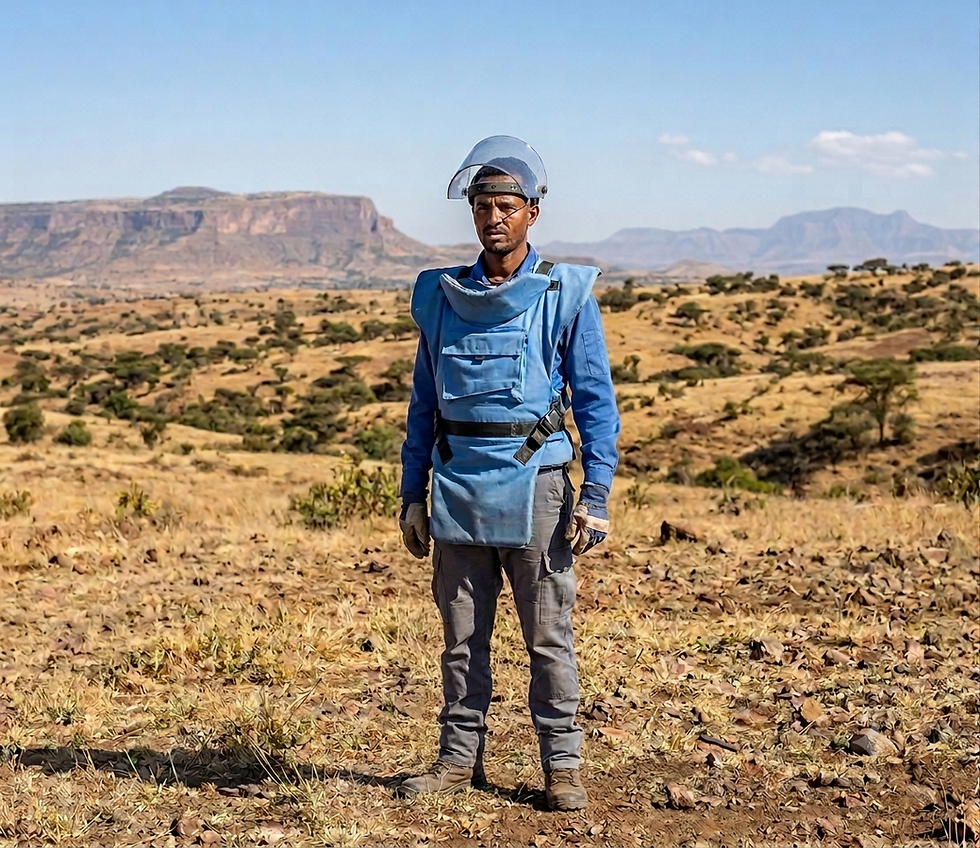
Land Release in a Divided Country: How Political Fragmentation is Undermining Mine Action Efforts in Libya

The Libyan armed conflict, which broke out in 2011 and led to the fall of Gaddafi’s regime after eight months of NATO-led intervention under the Responsibility to Protect (R2P) doctrine, has continued to affect the country’s stability and institutional cohesion. Due to the extensive use of artillery and other explosive ordnance by both Gaddafi’s forces and the rebels, Libya today faces widespread contamination from unexploded ordnance. In response, the Libyan Mine Action Centre (LibMAC) was established to coordinate clearance efforts and develop a national system to address the crisis. Initially, LibMAC’s challenge was not only operational but also institutional: transforming wartime improvisation into a professional, standardised sector. With support from actors such as UNMAS, efforts focused on developing procedures, training personnel, and aligning Libya’s mine action practices with international standards. Available mine-action data suggest a very large contamination footprint, though precise national totals remain uncertain due to incomplete survey coverage and shifting front lines. LibMAC has recorded over 436 km² of contaminated areas, while Mine Action Review estimated 286.8 km² of mine contamination by the end of 2020. UNMAS expert Bob Seddon further indicates that Libya retains an exceptionally large uncontrolled ammunition stockpile, estimated at 150,000–200,000 tonnes, contributing to recurring re-contamination and long-term civilian risk. Despite the clearance of more than 1 million explosive remnants of war since 2011, the scale and persistence of contamination continue to pose major humanitarian, security, and recovery challenges. (UNSMIL, 2024; UNMAS, 2026).
Yet, more than a decade later, clearance alone has not translated into recovery.
The 2014 Dignity Operation led by the Libyan Arab Army Forces (LAAF) against the Islamic State (IS) and the Shura Council of Benghazi Revolutionaries, followed by the 2019 conflict, exposed a deeper issue: mine action in Libya is not just technical; it is highly political. Institutional fragmentation has limited LibMAC’s effective reach; for example, all clearance activities conducted by international organisations, including the Danish Refugee Council (DRC), Danish Church Aid (DCA), and the HALO Trust, have been stopped by the Eastern government in late 2023 until May 2024 – and have not yet resumed despite the lifting of the suspension. This incident led to LibMAC’s oversight largely concentrating in western Libya, while eastern and southern areas were inconsistently supervised. In these regions, contamination is often addressed without unified national validation, or in some cases, left untreated altogether. This fragmentation directly undermines trust. Land that is technically declared clear (Land Released) is not necessarily perceived as safe. Sites cleared by international organisations may remain unaudited by LibMAC, while areas declared safe by authorities in the East may lack recognition in the West. As a result, “land release” becomes a contested label rather than a shared guarantee of safety. It’s worth mentioning that LibMAC had attempted to establish a regional mine action centre (RMAC) covering the East and South; however, political disputes and the lack of vision left the RMAC more or less paralysed.
The international commitment to maintaining a single, unified mine action authority, intended to promote institutional coherence in Libya, has had the unintended effect of further complicating the operational environment. UNMAS’s alignment with one government within a politically fragmented context may have been a pragmatic step at the time, but it has contributed to uneven oversight and challenges related to perceived legitimacy. In practice, this has resulted in parallel realities, whereby areas may be formally declared cleared yet remain socially and politically inaccessible.
This raises a fundamental question for mine action in Libya: Is clearance enough?
If communities do not trust the institutions that certify land, or if political divisions cast doubt on the validity of the clearance, then technical success risks becoming operationally irrelevant. Recovery cannot be measured solely by the number of square metres released; it must also account for whether land is actually reoccupied, cultivated, or reintegrated into economic and social life. Benghazi provides a telling example: land cleared by an international organisation in 2019 in Qanfouda remains unoccupied to this day, showing that formal release does not necessarily produce return, investment, or recovery.
Rethinking mine action in Libya requires moving beyond a purely technical model toward one that incorporates trust, legitimacy, and local perception. Institutional actors across both administrations should work together to develop cross-regional validation mechanisms, stronger community engagement, and a more flexible approach to institutional partnerships in politically fragmented contexts. Without this shift, Libya risks producing “cleared” land that remains, in practice, unusable and a recovery process that exists more on paper than on the ground. Additionally, international actors such as UNSMIL, embassies, and UNMAS should provide more support and coordination to mine action actors, including local organisations operating in the East and the South. This engagement would help LibMAC to gain more access, for example, by signing MOUs with local municipalities, which will help not only in the ability to conduct land release in other regions but also have the endorsement of local municipalities, which reinforces the trust and the legitimacy of the process. Ultimately, the success of Libya's recovery will depend not only on the removal of physical threats but on restoring confidence in institutions, empowering local ownership, and uniting efforts toward a future where reclaimed land truly supports safe and sustainable development.
Finally, despite these continuing constraints, UN agencies, international actors, and local organisations continue to make substantial contributions to mine action in the country, which should be recognised. Operating in a highly fragmented and politically heated environment, these actors have contributed to reducing immediate civilian threats, strengthening technical competence, and sustaining clearance efforts under extremely difficult conditions. Their sustained participation is critical not just for addressing explosive contamination, but also for promoting institutional coherence, restoring trust in land release processes, and furthering recovery in a genuine and sustainable manner. Mine action in Libya continues a long-term community effort that relies on ongoing coordination, local ownership, and international support.

Ibrahim Alghadamsi is Co-Founder of Mine Action News. He is a humanitarian mine action professional with over 10 years of experience across the Middle East and North Africa, specialising in programme management, operations, and sector coordination. Ibrahim has supported mine action initiatives in Libya and the wider region, focusing on mine action clearance activities and project implementation. He holds a Master’s degree in Conflict, Security and Development from the University of Sussex and a Bachelor’s degree in Petroleum Engineering from the University of Benghazi.